Wat Paknam in Half a Day — the White Chedi and the Green Glass Stupa, by Train from Khlong San
🚆 Gold Line → BTS → MRT · ~1 hour🕗 Out 08:30 · back ~13:00🛕 Free entry · shoes off inside the chedi🍜 Talat Phlu for lunch, on the same BTS line home
Illustration · Wikimedia Commons
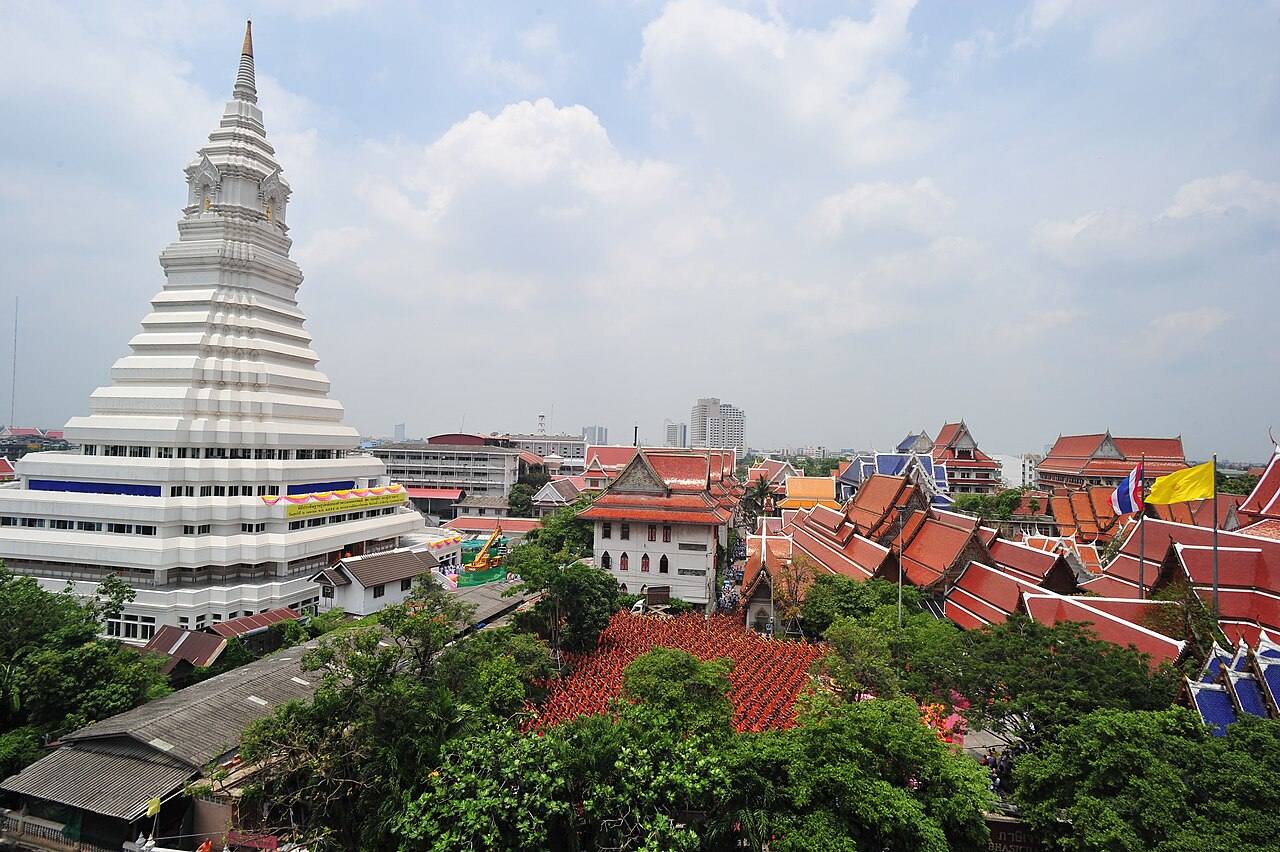
Wat Paknam is the temple guests most often show us a photo of and ask, “How do we get here?” The photo is usually the green glass stupa under a domed ceiling painted with the Buddhist cosmos, on the top floor of the great white chedi in the middle of the temple. It is on the Thonburi side like us, but further west on Khlong Bangkok Yai, with no express boat anywhere near it. The easy way is three train lines in a row: about an hour, and no traffic at all. This page covers the changes, the order to see things in, and the etiquette of a temple where people still come to meditate every day.
Why by train, and why in the morning
Wat Paknam is about 7 km from us by road, and by mid-morning Phetkasem Road and the Wongwian Yai junctions are slow enough that a car takes as long as the train or longer. The train is predictable every time: the Gold Line from Khlong San station, close to the hotel, to Krung Thon Buri; the BTS Silom Line to its terminus at Bang Wa; then one stop on the MRT Blue Line to Bang Phai. On the MRT stretch you can see the temple’s giant Buddha from the window. The reason to go early is the sun: the chedi and the courtyards are white concrete that throws the light back at you, it is hot after noon, and at weekends merit-makers arrive in numbers by mid-morning. Arrive before 10:00 and there is still room to stand on the top floor.
The route — Khlong San station to the glass stupa, and home via Talat Phlu
08:30 — Gold Line, Khlong San → Krung Thon Buri (2 stops) Walk from the hotel to Khlong San station, the start of the Gold Line, and ride 2 stops to Krung Thon Buri. Follow the signs to the BTS Silom Line platform towards “Bang Wa” — you stay inside the BTS system.
08:45 — BTS Silom Line, Krung Thon Buri → Bang Wa (5 stops · ~12 min) Through Wongwian Yai, Pho Nimit, Talat Phlu and Wutthakat to the end of the line at Bang Wa. Remember Talat Phlu — you will stop there on the way back. At Bang Wa you leave the BTS and follow the signs to the MRT Blue Line. The two systems use separate tickets, so buy a new one or tap a different card.
09:05 — MRT Blue Line, Bang Wa → Bang Phai (1 stop), then walk to the temple (~10–15 min) Take the train heading towards Tha Phra (not Lak Song) for one stop and watch out of the window: the giant golden Buddha rises above the rooftops. Get off at Bang Phai and follow the signs for Wat Paknam, through a residential neighbourhood and narrow lanes. If it is already hot, or you are with older travellers, take a motorbike taxi or a short Grab from outside the station.
09:30 — Phra Maha Chedi Maharatchamongkhon: go straight to the top floor (~45 min) The great white chedi in the middle of the temple is the main event. Take your shoes off at the entrance and head to the top floor first, before the crowds. Up there is the small green glass stupa in the centre of the room, under a domed ceiling painted with the Buddhist cosmos — the shot you have seen online is taken from here. You can sit on the floor and take photos, but no flash near anyone meditating. On the way down, stop at the lower floors, which display Buddha images and the temple’s collections.
10:20 — The giant Buddha and the Khlong Bangkok Yai bank (~30 min) Walk to the back of the temple for the giant seated Buddha, about 69 m tall, that you saw from the train. Close up, it is obvious why it can be seen from kilometres away. One side of the temple runs along Khlong Bangkok Yai, where long-tail boats pass now and then, and there is shade there to rest before walking back to the station. This was the temple of Luang Pho Sodh Candasaro, a monk revered across Thailand, so you will see people paying respects at his statue all day.
11:00 — Home via Talat Phlu, back around 13:00 Walk back to Bang Phai, take the MRT one stop to Bang Wa, then the BTS back towards town and get off at Talat Phlu, Thonburi’s eating district, right under the tracks. Find lunch in the lanes around the market, then continue on the BTS to Krung Thon Buri and change to the Gold Line for Khlong San. If you would rather not change trains, a Grab from the temple to the hotel takes about 20–30 minutes depending on traffic.
Dress and shoes: shoulders and knees covered, no vests or shorts. Shoes come off before you enter the chedi; bags for them are provided or you can carry them up. Slip-on shoes make life easier, as you take them off more than once.
People really do come here to meditate: the upper floors of the chedi have people sitting in meditation all day. Speak quietly, silence your phone, and do not stand in front of or photograph anyone sitting. Never point your feet at a Buddha image; when you sit, tuck your feet to the side or cross your legs.
Two ticketing systems: the Gold Line and the BTS Silom Line share tickets, but the MRT is a separate system. If you pay by tapping a bank card, check that each system accepts yours; when in doubt, buy a single-journey ticket at the machine. Fares are on the boards in each station.
Budget for the whole route: free entry to the temple, train fares there and back across the three systems by distance, and lunch at Talat Phlu at ordinary local prices. Add one Grab fare if you take a car home. Donations are entirely up to you — nobody will ask.
Which day: weekdays are clearly quieter. Buddhist holy days and long weekends bring large crowds of merit-makers; the temple stays open to visitors but the top floor gets packed, so arrive before 09:30. This route uses only trains, so the weekday-only express boats make no difference.
Common questions
Is a Grab straight from the hotel better?
Early in the morning or after noon, when traffic is light, a Grab takes about 20–30 minutes with no changes, which suits groups and older travellers. But in a weekday mid-morning Phetkasem Road is slow enough to make the time unpredictable, while the train takes about an hour every time. Our suggestion: go by train, and take a Grab back if you are tired.
Does it cost anything to go up the chedi, and when does it close?
There is no entry charge. The temple is open to visitors through the day and closes before dark; we do not print fixed times because they shift around temple events. Following this route you arrive around 09:30, so timing is never a problem. If you plan to go late in the afternoon, message us and we will check first.
Is it OK with children?
Yes. Most children enjoy riding three train lines and get excited when the giant Buddha appears in the window. Inside the chedi it must be quiet, so tell them before you go up that people are meditating on the top floor. The walk from Bang Phai station is the only part that may tire them; with a pushchair, take a short ride from outside the station.
* Temple hours, train fares and the walk from Bang Phai station are approximate and can change; the height of the Buddha is as published by the temple. Check the signs on the day or ask us before you set off.
Written by the House of Happiness team · Last updated